
Nicole Jansen: Leading with God’s Grace
Updated: Sep 12

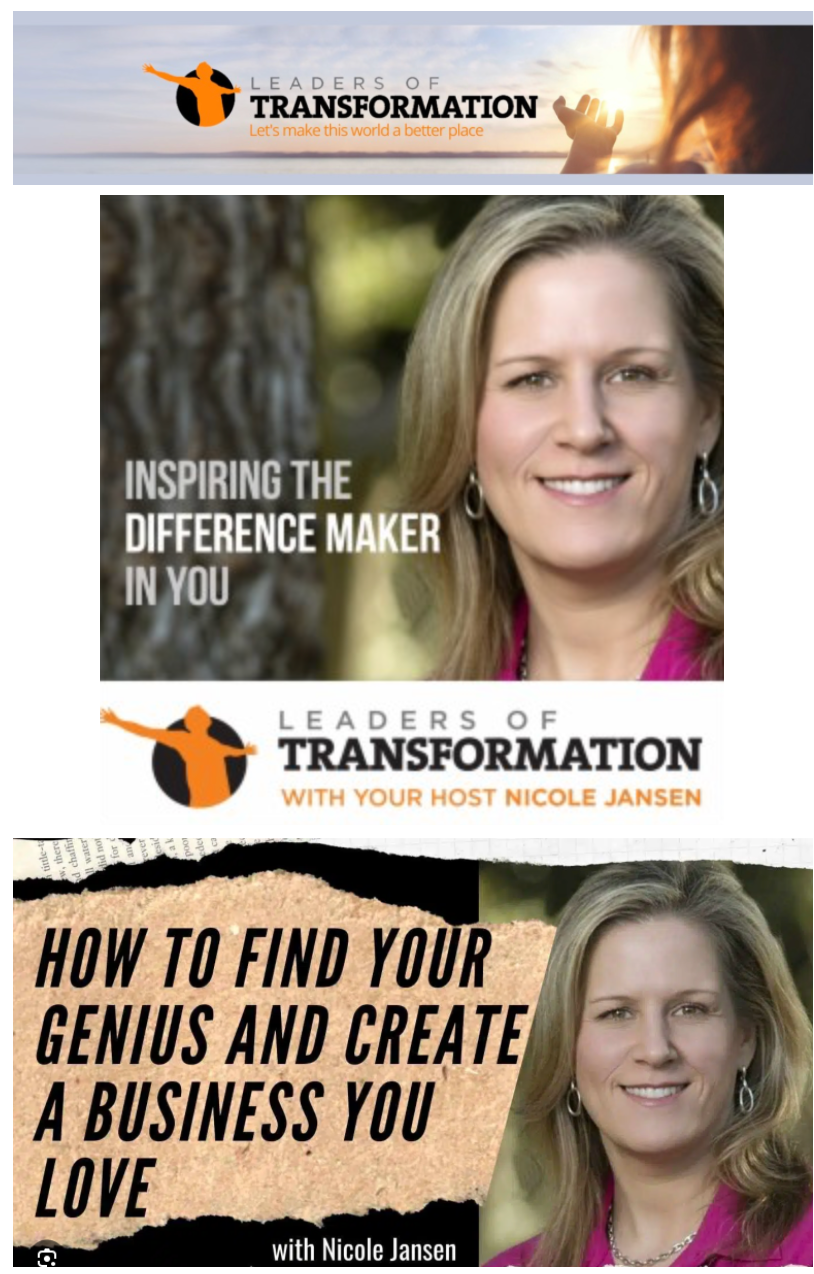
Starting her entrepreneurial journey at the age of 15, Nicole Jansen utilizes her wealth of experience and divine guidance to empower leaders. She collaborates with small family-owned businesses, large franchise groups, and major corporations. In this episode, Nicole reveals her top 3 leadership skills, highlights common leadership errors, and much more.
Beyond offering practical advice on cultivating mindset and leadership abilities, the most profound insights in this episode stem from her spiritual path, which began with a pivotal moment at 14 years old. She shares a poignant narrative of setbacks — business failures, relationship loss, and the passing of her parents. At her lowest ebb, she found solace in God's call to "come and rest," a turning point that reshaped her life. Discover how her faith-driven approach to supporting business leaders aims not just to assist but to effect transformation.
Nicole's immensely popular podcast, "Transformational Leadership," has reached millions of listeners in over a hundred countries with more than 500 episodes since 2015.
Furthermore, she provides coaching, consulting, and speaking services to business leaders, imparting her inspired wisdom to both religious and non-religious leaders, guiding them towards a fresh perspective by refining their mindset and embracing their true potential. Her mission goes beyond mere profit generation; it's about embodying the essence of a transformational leader.
For inquiries, reach out to Nicole at:
or visit her Website at:

NICOLE JANSEN AT A GLANCE
Business Coach • Transformational Leadership Coach • Speaker • Podcaster • Host of Leaders of Transformation
Topics
Christian faith • Transformation • Leadership • Business • Entrepreneurship • Coaching • Identity • Purpose • Hearing God • Holy Spirit • Faith in the workplace • Self-awareness • Vision • Empathy • Consistency • Personal transformation
Her Faith Journey
Christian identification without a strong church background → Encountering Christ at age 14 → Building a personal faith through Scripture and prayer → Business success and devastating financial loss → Marriage, divorce and the loss of both parents → Discovering that her identity was in God rather than achievement → Learning to rest in God → Rebuilding her life and marriage → Helping leaders discover their purpose and God-given identity
This Episode Explores
Nicole's remarkable 35+ year journey as an entrepreneur and business coach
How she came to faith at age 14 during a large Christian conference
Losing an eight-figure family business and asking God, "Why did this happen to us?"
How divorce and the loss of both parents deepened her faith and changed her understanding of identity
The powerful message she received from God: "Come away with me and rest"
How her podcast, Leaders of Transformation, began during one of the most difficult seasons of her life
How Nicole distinguishes God's voice from her own thoughts and the voice of fear
Her belief that the Holy Spirit can guide her while coaching clients
What transformational leadership really means and why leaders must transform themselves first
Questions Answered
Who is Nicole Jansen?
What is Nicole Jansen's faith story?
How did Nicole Jansen become a Christian?
What happened to Nicole Jansen's family business?
How did losing her business affect Nicole's faith?
How did divorce and the loss of her parents transform Nicole Jansen?
What does Nicole Jansen mean by "your identity is in God"?
How does Nicole Jansen hear from God?
How does Nicole distinguish God's voice from fear?
What is transformational leadership?
Podcast transcript
Podcast Transcript: Nicole Jansen on Transformation, Faith, Leadership & Finding Your Identity in God
Amazing Greats with Ric Hansen
Guest: Nicole Jansen — Business Coach, Speaker, Podcaster and Transformational Leadership Coach
The Power of Transformation
Ric Hansen: Hi, I'm Ric Hansen with Amazing Greats. Thank you for joining us here today.
You know, transformation means more than just changing some things up. It's about a whole new approach, a new way of thinking and a new paradigm.
Our guest on this episode is Nicole Jansen, who believes in the power of transformation. She's made it her life mission, and that is what she's sharing with us in this episode of Amazing Greats.
I think you'll be moved by her faith journey and her personal transformation, and by how she has coached thousands of leaders over the last 30 years.
We have as our guest today a lady who's been doing what she's done for 30 years, and that is a coach, a counselor, a speaker and a podcast host, all centered around business.
Some of our most-listened-to podcasts are always about business because there's this seeming challenge of merging spirituality with the rat race of the business world that we live in.
So we're going to try to talk about all of those things in the next few minutes.
You've been doing this for 30 years, and podcasting since 2015. Is that right?
Nicole Jansen:Yes.
Ric Hansen:Holy moly. And over 500 episodes, which is crazy.
I know what it takes to do a podcast now, and 500 of them is a lot of podcasts. I mean, it's about getting the interview, scheduling the interview, prepping for the interview, editing after the interview, and then finding an audience to present the video or the audio to.
So congratulations on that.
Tell me a little bit. You're a coach and you coach in the area of business. What kinds of businesses have you had an opportunity to help in?
A Lifetime in Entrepreneurship
Nicole Jansen:First of all, Ric Hansen, thank you for having me here. I am excited. I've been watching your episodes and just so inspired by all the stories that have been on this show. So I'm like, "Man, I'm intimidated!"
But yeah, it's good.
I have been in entrepreneurship my whole life—and now actually over 35 years. I'm 52 now. I started when I was very young.
My parents owned businesses, franchises, then got involved in direct sales. I dove in there and helped them in their business, and that became very successful.
At one point, I ended up partnering with them, and we had businesses all around the world.
I had also started my own business when I was 16 years old—my first official business, not those things that you do on the side, which I did even before then.
I just knew I wanted to be in business for myself. I didn't know exactly what that looked like. I didn't have any specific, "Oh, I want to sell this," or "I want to create this product."
It was more just the idea of owning a business.
In the process of figuring out what that was going to look like, I've done a lot of things and gotten a lot of experience in different arenas.
So now, as I coach entrepreneurs, I'm able to bring all of that to the table.
I've worked with small mom-and-pop businesses. I've also worked with large franchises.
Actually, one of my clients was in space exploration, and so we had a lot of fun with that. We were talking about going back to the moon and excavating all of the resources. Fascinating stuff.
He was bringing together these amazing scientists and engineers and putting these workshops together. He needed the team in place to be able to work well together to make that possible, and he also needed to be able to scale the business because he was putting his own money in.
You just can't do that for too long before you start to run out of money.
So we were helping him with the business side of it and growing that.
I've worked with all sorts of different businesses.
The focus of every single one of those businesses has always been the mission.
When I was growing up, my parents just innately understood that business was about creating value. We talked about the mission, the goal, what we were creating, and it was more than money.
So it's always been about that for me.
Growing Up and Discovering Faith
Ric Hansen:Well, let's start with your growing-up years, and let's jump into your faith journey right off the bat because it usually starts with some kind of foundation along the way.
Did you come from a Christian home? Is that where it started?
Nicole Jansen:Well, I would say yes and no.
They identified as Christian. They also worked seven days a week. They had the garage business with the gas station, so it was open seven days a week.
People would call us on Sunday night and say, "Hey, my car broke down," and my dad would go off and help them and so forth. My mother was doing paperwork and stuff.
It was a nonstop thing.
I had never actually been to church in the first 10 or 12 years of my life, other than going with a friend of mine to Mass.
In fact, my mother and I were driving down this major road where I'm originally from, Toronto, in Scarborough.
I remember seeing this beautiful building. It had all the glass and cathedral stained glass, and I was like, "That is so beautiful. Do you think one day I'd ever be able to go in that building?"
And she said she felt so bad because I didn't even know it was a church. I was just like, "This is a gorgeous building," because I love architecture.
Then she realized, "You know what? We're not really doing a good service to our kids by the lifestyle that we live."
When we got involved in direct sales, it was very much a faith-based environment.
When we would go to conferences, they would have a Sunday worship service. That's really where my faith journey started—listening to these amazing speakers like Charles Stanley and many others, live.
I mean, it was just amazing.
When I was 14, we were in this Coliseum with 25,000 or 30,000 people, and I decided that I wanted to go forward.
So I did.
I was actually afraid that everybody would be looking at me. I'm 14—really, who's looking at me?
But I was worried about what people thought. Like, "Oh, I must be a wretched sinner if I'm giving my life to Christ."
But nobody was paying attention.
Everybody was just doing their own thing.
It was that struggle, you know? And I think we all have that story of whatever that is for different people.
But it was the story of just giving my life to Christ and saying, "You know what? I need a Savior."
Learning to Build a Personal Faith
Ric Hansen:And the classic altar call.
I love the whole concept of the altar call because it has worked for millions and millions of people, where that moment becomes your opportunity to go to the altar and receive Jesus.
That's very cool.
Out of that, there must have been some growth period—finding out, "What did I just do? What was that? What is this all about, really?"
Tell us a little bit about that.
Nicole Jansen:We came back to Toronto, looked for a church, and couldn't find a church that really had the same kind of energy, vibe and Spirit-filled environment that we had found down there.
So we bounced around to a few different ones.
I actually just started reading the Word myself.
I said, "Okay, God, if this is Your Word, then show me what it means."
So I just started reading it every day.
In our community, we would have a lot of conversations and so forth.
I actually thought that my faith was quite strong. I thought, "I've got this. God, we're in this together."
But it's only when you go through difficult seasons that you really know the basis on which your faith is founded.
Losing Everything
Ric Hansen:Did you have a difficult time that was prominent in your growth?
Nicole Jansen:Well, yeah.
I'll just fast-forward it.
I was in my mid-20s, and my parents and I had gone all-in in their business. We had grown this business into an eight-figure business in the early to mid-90s.
I thought that's what I was going to do for the rest of my life.
We poured our lives into it seven days a week, like I said, and just poured our lives into it.
Through a series of events and people that we had been in business with who became very greedy and power-hungry, the whole thing fell apart and we lost everything.
I watched my parents lose everything. That was the second time.
The first time was when I was 11 or 12 years old, and that's a whole other conversation.
When this happened, it wasn't just the financial aspect. It was the relationships.
It was literally pouring decades into something that I thought was what I was going to do for the rest of my life.
When that fell apart, I really saw God and said, "Hey, you know what? We're good people. Why did this happen?"
That was the question.
Sure, I'd had those thoughts in business before. When you struggle in business, you think, "I'm going to start my business at 16. I'll be a multimillionaire by the time I'm 18 or 20."
When that didn't happen, I had that question too: "Why is this not going faster?"
But watching my parents go through that again at an older age really was a pivotal moment for me.
I worked through that, and I just said, "God, You've got to walk me through this. You've got to walk us through this. What do I do now?"
I literally put all my eggs in one basket, and that basket just broke and all the eggs broke.
"What do I do now?"
He walked me through that process, really extracting all of the lessons.
That's where the coaching came in, because I had been informally coaching for years with our team. Now I turned that into a formal training and development company.
The Compounding Loss
Nicole Jansen:Then the next level of my faith was about ten years ago when I got married.
I had another business that I had bought—a franchise—and it fell apart. The system itself was dysfunctional.
I ended up walking away from that.
I got married and moved down to California with my husband.
A month later, after I walked away from the franchise and gave up my investment—I still had all the debt, but I had given up my investment—my husband said, "Yeah, I don't want to be married again. I don't want to be married anymore."
And I was like, "Are you serious?"
It's just one thing after the other.
That's when I think you really get to the point of what I call the "compounding loss."
It's like, "God, really? How much do I need to go through?"
We walked through that for a number of years.
I tried everything possible that I could to salvage it.
What did I need to do?
I took it personally. I went through that whole process of taking it on for myself.
Then God showed me and said, "Your identity is in Me, not in what somebody else says."
We ended up getting divorced.
In the process of that, I also lost my mother and my dad. They died within two weeks of each other, two years apart.
It was just all of this stuff happening at once.
I was tired. I was really tired.
When we got divorced, there was a happy ending. Three years later, we did get reconnected and got remarried. It's amazing.
But that period of time, I was like, "God, I am just tired. I'm tired. I feel like I've been fighting my whole life, and I just don't know what else. I'm done."
And He just said to me, "Come away with Me."
I went up to Northern California, and He just said, "Come away with Me and rest."
In the process of that, because I had been in crisis, I had developed this pattern of "What's the next thing?"
And He was like, "I just want you to come and rest in Me."
So I did that for a number of months.
Eventually I came back the next year. I went to Northern California, Canada, and then came back and started to rebuild my life.
And like I said, three years later, my husband came back and said, "Hey, I'm ready. I'm ready to do this thing."
That was a whole other conversation we could get into.
But that's all by God's grace.
All of that, the common denominator was God working in my heart to go from the performance mindset of doing—my identity being in what I can accomplish and how much we can amass—and He's saying, "It's not about any of that stuff. It's about your relationship with Me. Who you are—you are who I say that you are, and not who the world says you are."
That process of losing again everything, and even family—I don't have a big family, so it's like, that's it. I've got my brother and his family.
And really having nothing, leaving the home and just being like, "Okay, where do I go? I don't know."
He was saying to me, "You think you've lost everything, right? But you have Me, so you haven't. This is what's most important."
I remember journeying and saying at one point, "Wow, God. It really is You and me on this journey called life. It really is You and me. So where are we going? What are we doing?"
From Crisis to a Podcast
Ric Hansen:You know, I love that. "Lose yourself to Me," basically, is the message.
Sometimes when things are going well and you think you know where you're supposed to go, you kind of ignore that until He makes it pretty obvious.
Nicole Jansen:Every time I say, "I've got this," God's like, "Girl, let me tell you what you got. Pride. So we're going to deal with that."
Ric Hansen:So you are remarried and things are good with regard to that. Life is good, business is good, and it's all thanks to really losing yourself and giving it up to God.
That's incredible. That's wonderful.
Nicole Jansen:It's rebuilding.
God has been rebuilding me on a better foundation—on that identity.
The podcast you mentioned in the beginning started in 2015.
I'm in the midst of all of this. My husband had just moved out. We were living separately in the same place for a while and trying to work that out.
He had just moved out, and everything was falling apart around me.
One morning he woke me up. It was about 4:30 in the morning, and I had been praying.
I was like, "God, what do I do? I am so emotionally strained. I don't think I can create content and do all the things that normally coaches do."
He woke me up. It was 4:30 in the morning on a Saturday.
He said, "You're going to do a podcast, and it's going to be called Leaders of Transformation. You're going to interview difference-makers and world-changers. Go."
And I was like, "The what? What are we doing?"
I said, "When am I doing this?"
He said, "Now."
I mean, I was like, "Now-now, or like business plan, marketing strategy now?"
He said, "Now."
So I got up. I called somebody I knew who had done some podcasting.
I said, "What do I need to know about this podcast?"
He was four hours ahead, so he was awake.
We were live three weeks later.
I said, "God, if this is Your idea, then You're going to make it happen."
I may not be able to create my own content, but I can interview great people.
What a blessing that was.
Because in the process of that, environment is so important. Association. Who we hang out with.
I was here in LA by myself, just feeling all sorts of chaos around me.
I could have conversations with people who were making a difference in the world—transformational leaders, friends of mine that I may not have stayed in touch with.
Now I was having them on my show, and they introduced me to other people who introduced me to other people.
It was like a lifeline.
Hearing From God
Ric Hansen:And their stories that you're sharing with the world became powerful for your personal journey as well, I'm sure, right?
That's the same way with me.
When I started the podcast, one of the greatest gifts of doing this is talking to people like yourself and other people who just load you up with wonderful, positive Christian power.
It's fuel. It is totally fuel.
So that is fantastic.
When we originally connected, I had no idea about your story. This story is just phenomenal.
When you get a word from God, how do you get that?
Some people question, is it actually audible? Is there audio there? Is it a thought or a feeling?
Can you explain what happens with you?
Nicole Jansen:Yeah, I think everybody's different.
God can talk through all sorts of things, right?
He can even speak to me through movies, and I'll be like, "That one was for me. Okay, got it."
But for me, most of the time it's not like I hear a loud voice.
It's kind of like an inner voice, and it's a knowing.
I just recognize it as Him speaking to me internally.
We all have little voices.
I remember one of my mentors used to say, "We all have that little voice."
"What little voice? I don't have a little voice."
"That one. That's the little voice in our head."
But there's God's voice, there's the enemy's voice, and then there's our voice.
So it's differentiating between them.
When God speaks to me, He has spoken some pretty powerful things to me.
At one point I was like, "What do I do with my husband? He doesn't want to be with me. He tells me he'll never love me, all the things, and he's messing around and doing all the stuff."
And He just said, "Love your husband."
I'm like, "Well, how am I supposed to do that?"
I think He talks to all of us in the way that we need to be spoken to.
Based on my personality, there are times where I've been like, "Oh, okay, God. So I know You want me to take the Sabbath day, right? Because seven days a week is how I grew up."
And He's like, "I'm sorry. Time out. I don't need you to take the Sabbath day. You need the Sabbath day."
And I'm like, "Oh, wow."
He'll speak to me in that inner voice.
If it's always loving, it's convicting sometimes, but it's not condemning.
Whereas when I hear the voice of the enemy, it is usually very fear-based. It's condemning. It's limiting. It's criticizing me about what I shouldn't do, or blaming, pointing fingers.
Or it's, "You need to do this right now."
You know, like when you've been to seminars and they do the back-of-the-room promotion and they're like, "Run to the back of the room and buy this thing!"
I've had clients call me and go, "But it's such a good deal!"
It's like, "Just calm down. Pray about it. If it's not a good deal tomorrow, then it's probably not a good deal."
It's really having that time—even if it's just a moment—to pray into it and say, "God, is this what You want me to do?"
And to have the peace inside to know when you're hearing from Him.
When we're all excited and trying to rush into something, those are the decisions that—whenever I've done that, high emotion, low intelligence kind of goes hand in hand.
When I've done that, I've always made foolish decisions.
It's been a process for me to differentiate that.
God speaks to me, there's peace.
When the enemy speaks to me, there's always anxiety. There's always tension, fear, fear of missing out.
I have to do something right now.
It's very different.
The Holy Spirit in Coaching
Ric Hansen:Do you feel the work of the Holy Spirit while you're in coaching mode?
Say you're talking to someone. Do you feel like you've really been gifted with an idea or a way out, or however that works?
Is that part of it as well?
Nicole Jansen:Yes.
I've literally coached thousands of people.
I would say humbly, I'm a good coach, but there are things that I say that I'm like, "No, that's good. That is not me."
I'll sit here sometimes with this little notepad beside me, and I'm like, "That was good. I need to write that down and meditate on that later for me."
I know.
As a coach, there are a lot of coaches out there who have structures and agendas and things that they go through.
I have an agenda, but I have a framework that's very simple—so simple that clients wouldn't even necessarily notice it.
They just think we're having a conversation, but I'm moving through a process.
The biggest thing is to be fully present in the moment.
I need to make sure that my stuff isn't showing up in the conversation.
So I pray beforehand.
And if I have clients who are not faith-based—that's not all of my clients. For many years it was largely secular with a few faith-based. Now it's sort of moving in the other direction.
Regardless, it's about being fully present and saying, "Lord, have Your way and speak through me."
So I'm listening.
It takes a lot of energy to really focus on what's actually happening, what they're saying, what they're not saying and what God is speaking to me.
I had one client who was a former Goldman Sachs VP and all this.
She kept reminding me how amazing she was.
She's really sweet. She's like, "I'm a subject matter expert."
I was like, "Okay, got it. You've told me that like 17 times. Got it."
We're in the middle of a session, and I just felt like I needed to interrupt her.
I said, "Can I ask you a question? Who do you need to forgive right now?"
I'm just putting it out there.
Literally, she was like, "What?"
And then the tears came.
It was just like—God knows.
He's like, "Just get past all of this stuff and let's just cut right to what's really going on."
That's a privilege.
That really is a privilege.
What Is Transformational Leadership?
Ric Hansen:That is so powerful and eye-opening too.
Let's talk about leadership for a minute, because that's what you're all about.
You've had the opportunity to talk to thousands of entrepreneurs and CEOs and all of that, as well as through the podcast.
What would you call your description of transformational leadership?
Nicole Jansen:Just to say something about the leadership piece: when I started the podcast, I was like, transformation is the operative word. It's not leadership.
I'm not about leadership. I'm about transformation.
Then eventually God's like, "No, it's transformation, it's leadership. Just get it—that it's leadership."
I think I struggled with that because of past experiences we had in business.
I've seen really poor leaders, and I didn't really want to be associated with that.
I never even saw myself as a leader. I was just doing what I was doing.
At some point, though, I realized it's all leadership.
Leadership is leading ourselves before we can lead others.
When I look at transformational leadership, it is really about transforming something.
When you change something, it's kind of like you're moving it and it's different, but it's not completely transformed.
Transformation is creating something completely new.
We need to be transformed by the renewing of our minds.
It's a whole new way of thinking.
As leaders, it's important that we are transforming ourselves, but that we're also creating the environment for people around us to be transformed by the renewing of their minds.
How do they see themselves?
How do they see what they're capable of? Their giftings? Their strengths?
I believe leadership is, yes, casting a vision and all of that, but it's really about creating that environment where the best version of them can show up.
Three Characteristics of Successful Leaders
Ric Hansen:Let's talk about leadership characteristics.
Now that you have an opportunity to work with and observe leaders, what would be three of the characteristics of successful leaders that stand out to you?
Nicole Jansen:I think one of the first ones is vision.
If you're not going anywhere or you're just wandering around aimlessly, then you're not leading—whether you're leading yourself or leading others.
The Bible says that without vision, the people perish.
That's first and foremost.
The second thing is that you need a certain amount of empathy.
There's power in empathy.
Obviously, there's authority: "Hey, we're going this direction."
But there's also empathy and recognizing and loving on people.
That's one of the things that I started out when I launched my business—teaching personality dynamics.
Every business is a people business.
You need to understand people and understand that people are not always going to think the way that you think.
Number three, I would say, is consistency.
Competence and all of those things are important, but consistency is huge.
They need to be able to trust you. They need to know they can count on you.
If you're wavering all over the place or constantly changing, then I can't trust you.
So I would say vision, empathy and consistency.
There are others, but those would be my three.
The Biggest Mistakes Leaders Make
Ric Hansen:And what about the biggest mistakes that you see? Is it the lack of those three, basically, or is there something else that's more obvious?
Nicole Jansen:I think one of the things I see a lack of is self-awareness.
I had a guest on my show, and I forget who it was. He wrote a book on leadership.
He said that 70% of C-suite leaders do not know their identity or their purpose.
And I thought, "Well, how the heck are you going to lead others in creating and understanding that for themselves if you don't understand that?"
I think what they lack is self-awareness.
A lot of leaders will say, "I'm a good leader."
I've had leaders tell me that.
I'm like, "Well, would it be all right if we verified that? Let's ask a few people."
And they don't think the same thing.
So lack of self-awareness is one.
I think the other thing is that leaders don't take time because they're so busy.
"I'm so busy, busy, busy. I'm so important. I have so many things to do."
And legitimately, many of them do.
That's valid.
But you need that quiet time.
As a faith-based leader, you absolutely need that time of intimacy with the Lord.
You need to go to the source and get refilled so that you're operating from overflow and not from empty.
Leadership requires energy. It requires having something.
You've got to have something to give.
When you don't, as a leader, you start getting irritable.
You start lacking vision because you haven't connected to God, who is the vision-maker.
You don't have the empathy anymore because you're tired.
Now you're more into self-interest, self-preservation and survival.
You're also more likely not to have consistency because you're making quick decisions and reacting.
Coaching Secular Leaders
Ric Hansen:I can see where this works well with your Christian-based leaders.
What happens when you work with secular leaders as well? How do those conversations go without the faith aspect?
Nicole Jansen:I just talk about the principle.
I don't need to mention that it's from this Scripture or that Scripture.
I can say, "If you don't have a vision, your people don't know where to go. They don't know their purpose."
We have to have somewhere we're moving toward.
If I'm taking a trip, I'll use that analogy.
"If I'm going from LA to Florida, first of all I've got to know that I'm driving to Florida. I can't just say, 'We're going out for a drive.'"
I'll use different analogies and life experiences to help them get the point.
I've been doing that for years.
Now I'm actually putting the Scripture to it and saying, for those who are faith-based, "You understand that this is actually scriptural, right?"
And then it just adds that additional power to it.
Can Coaching Lead People Toward Faith?
Ric Hansen:By osmosis, have any of your clients actually made a pivot toward Christianity based on some of the things that you've talked about, or them being aware of your Christianity and modeling themselves maybe differently?
Has that been an avenue to conversion?
Nicole Jansen:Yes.
It's interesting because Jesus said, "You'll be known by the way that you treat each other."
There's this old saying: "Preach Jesus, and use words if you must."
It's been really interesting.
As I'm talking to people—and when I wasn't putting my faith out there—people would become curious.
"How do you stay so calm in the midst of all this crazy?"
"Where does this come from?"
"Where do you have all this wisdom and experience?"
"Yeah, I know it's from your life experience, but it's beyond that. Where does this come from?"
So they'll get curious about that.
I get to talk to people who are growing their business, but sometimes I'm talking to them and that business leader might be having something going on in their personal relationship.
Or they might have experienced something devastating, a tragedy in their family.
So I get to be there and support them through that.
Even though I do leadership coaching—which is the business side and all of that and how they're showing up in their business—you can't really separate the two.
I actually have a lot of clients who say, "Nicole's my life coach."
And it's like, "Okay, well, whatever. We'll just go with that."
I'm here to support you in being the best version of you, for you to be who God created you to be, whether I use that language with you or not.
That's what I'm always looking to do.
That's what God has called me to: to help people discover and play to their strengths so the best version of them can show up.
I've been in a room full of financial analysts, and people have come up to me afterward and asked me questions about their son.
We're not talking about any of that stuff.
And they're like, "Oh, you know what? I just had this epiphany about my son and why we don't get along."
So now we're having this conversation.
It's been truly a blessing.
Or they'll start off saying, "Church is like this and that," and they know that I'm a Christian.
Then they say, "Yeah, but what about this?"
And I just present it a little bit differently, and they go, "Wow, I've never heard it described that way."
The Reward of Transformation
Ric Hansen:The whole premise is transformation—rebuilding, transforming them.
Do you have situations where there are breakdowns? I'm talking tears because the transformation has been so impactful?
Nicole Jansen:Yeah, I have.
I get letters. I have a box of letters that people send me saying, "Thank you. Thank you for being there with me in the different seasons and things that they've gone through."
How rewarding is that?
It makes it all worth it.
I love what I do, but that's the part that is the most rewarding.
Usually people will come and, if they're secular—and even faith-based—they'll say, "Help me grow my business."
"Okay, so we'll do that. But let's first of all talk about you."
Let's talk about why you're in business.
Why are you in this business?
What's your purpose?
That just shifts the conversation.
It's like, "Yeah, we'll help you make more money. That's fine. But let's talk about the stuff that's really important."
And then that will come.
The reality is there's a result model that one of my mentors taught me, and I've been using it now for about 15 years.
I think it's so powerful.
Any result that we want to create in life requires certain behaviors and actions.
We've got to do something.
In order to have what we want, we need to do something.
But what influences our actions is our mindset.
And that mindset—how do you change your mindset? How do you shift that? How do you renew your mind?
And if you're not a believer, how do you do that?
Then it's about beliefs.
How are you seeing yourself?
There's your identity—your nature, how you were born, your strengths, your personality, all the things you've had your whole life that you were born with.
Then there's nurture—what do I believe to be true about myself, others and the world around me?
I call that "sow."
What are you sowing?
What you sow is what you will reap.
It's like a container.
If you want to create an increase in results, you've got to expand the container.
Who do you believe that you are?
And I mean, if you want to know the purpose of a thing, you ask the One who created the thing.
So why don't we ask Him?
Turning Around a Toxic Organization
Ric Hansen:A CEO lands a job in a new corporation that is not profitable, has a toxic environment and is full of backbiting.
What's their first move?
Where do you start with them in terms of, "What should I do to fix this?"
Nicole Jansen:The first step to transformation is always awareness.
You have to know where you're at.
Whether it's personally or in business, you've got to know where you're at.
Then you start looking at, "What's the plan?"
Then you discuss it with your leadership team.
"This is what I found. This is what we need to do from here."
I know that as a CEO, most of them want to stay high-level and so forth, but depending on the size of the organization, there's a certain point where you can go down and talk to those leaders or gain that information.
You just need to get it.
You need to get the truth.
It's the truth that sets us free.
Unfortunately, a lot of leaders are surrounded by people who will tell them what they want to hear and not what's really happening.
That's why you hear about so many of the great CEOs who would walk the front lines and talk to people and so forth because they're getting a pulse on what's happening.
That's number one.
And while you're doing that, you also have a board.
You've got to give them some honest expectations because they may think you're going to come in and roll heads and fire everybody.
It's like, "No. Do you want to create lasting change? Lasting transformation? Do you want to turn this around—not just for a short time, but legitimately turn the ship around?"
It's going to take some time.
You didn't get here overnight, and we're not going to change it overnight.
How to Work With Nicole Jansen
Ric Hansen:If somebody wanted your help as a coach, how do they go about doing that?
Is there a way to reach out to you and say, "Here's my situation. Can we set up a time specifically?"
What would somebody do?
Nicole Jansen:On my website, there is contact information where they can reach out to me.
Or they can email me directly at Nicole@leadersoftransformation.com.
We'll schedule a call.
On my Calendly, it's about 15 minutes.
But if there's somebody like a C-level executive from a company who says, "Look, we need to unpack this and figure out what it is," we'll spend some time.
Same thing.
I'm going to go in and be like, "Okay, what's going on, and how can I support you?"
Unless I know that I can make a difference, I'm not going to do it.
I've got to be able to make a difference and be able to be honest with you.
Ric Hansen:If you get some bad vibes or they're not going to be open to the conversation, you can step away.
Nicole Jansen:One hundred percent.
I've done that.
Sometimes that's hard.
I've fired clients before.
I've fired clients and said, "Look, you know what? I am more committed to your success than you are."
"I don't care if you don't want to get the coaching from me. That's fine. Just get it somewhere, because this isn't going to work the way you're doing this."
Just being honest.
I think we need to be willing to tell people the truth, even at the cost of a client or a retainer or whatever.
We need to be able to do that in order for people to trust us.
If I say, "Yes, I can help you," it means yes, I can help you.
But bottom line, you're the one who's going to do the work.
I've had clients say, "I need to be motivated."
I'm like, "Well, then already, right off the bat, there's something wrong here."
My job is not to motivate you.
If you're not motivated by what you're doing, we need to have a conversation around that first.
Ric Hansen:Yeah, your motivation for them would only last so long, and then they'll be right back where they were.
Nicole Jansen:Pumping them up doesn't work.
Anyway, they can reach out to me by email. We can schedule a time, and I can understand where they're at.
I'll ask them some key questions about what's going on, and then we can go from there.
Leaders of Transformation
Ric Hansen:Perfect.
Now tell me about the podcast.
That's free and available to anyone, and it's available on all the podcast directories, basically.
Nicole Jansen:Everywhere, everywhere.
I told you this is a God project.
God's like, "God, this is Yours."
We've been very blessed.
It's on all of the major platforms. It's a top 1.5% podcast globally, with listeners in 140 countries.
Literally, that was all God.
So yeah, it's anywhere.
If you type in Leaders of Transformation anywhere, you can find it.
Go to the website.
There are over 500 episodes and amazing guests who I've had a chance to talk with.
The Toughest Interview
Ric Hansen:One of the episodes was very interesting and fun.
You briefly touched on it.
There's two things I want to touch on before we leave, but we are running out of time.
This was the guy—I can't remember his name—but he was the one who was offering up characteristics of a good leader as it relates to the presidential election.
And I know you were desperately—
Nicole Jansen:He's not a believer, yeah.
Ric Hansen:Oh, he's a non-believer. I didn't know that.
Nicole Jansen:He's not a believer.
We set that up upfront before we started recording.
I said, "This is not about candidates."
We actually recorded that just before Kamala Harris accepted the nomination, or however that happened.
But yeah, he kept baiting, and I was like, "I'm not going there."
So, but he did have some really good points, and that's what I was pulling out of that.
That was probably—not probably, that was—the toughest interview that I've ever done because there was so much that I wanted to just...
And with that, I think we need to say adios, although this has been so refreshing and fun.
Ric Hansen:I hate to call it, but as you know, podcasts can only last so long, and then people have to go on with their lives.
Thank you so much, Nicole, for spending some time and sharing your story and being so inspirational and kind.
It's been a pleasure.
Thank you.
Nicole Jansen:Thank you, Ric. I've so enjoyed it. So enjoyed it. Thank you.
Closing Thoughts
Ric Hansen:Wow, so much packed into this episode.
It may take you a couple of listens to grasp it all.
Nicole Jansen—coach, speaker, podcaster and a new friend to our podcast, Amazing Greats.
Please share this episode with your friends and family, and give it a great review so that more people will hear God's inspired wisdom.
God bless.


Comments