
Singer Leon Patillo: From Santana to Hosanna
Updated: Sep 12

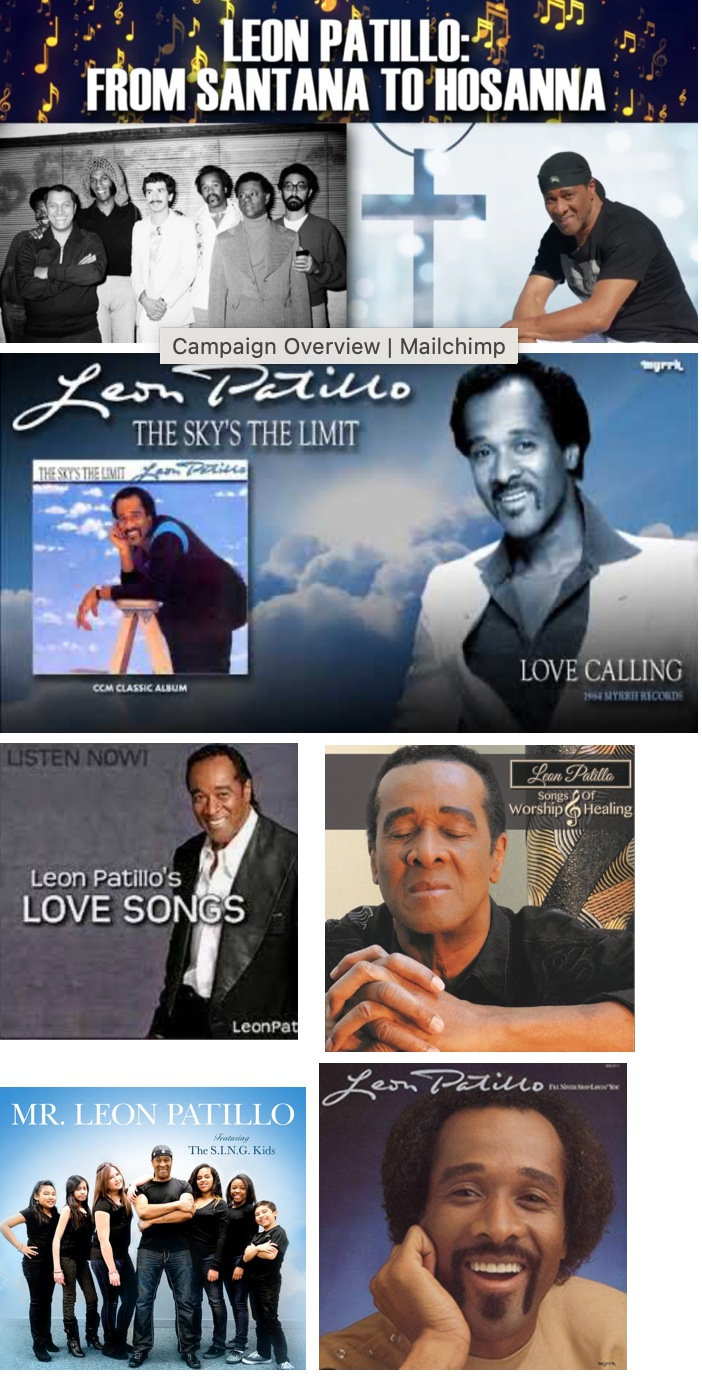
He was the lead singer of one of the worlds most popular rock bands, and hung out with the likes of Smokey Robinson, The Pointer Sisters, Earth Wind and Fire and more. Leon Patillo was the lead singer for Santana and his music career was legendary. In the late 70's his life pivoted and he made the dramatic switch to what turned out to be the very beginnings of Contemporary Christian Music. Creating music that worshiped God with lyrics of praise in a totally new musical form with catchy choruses and rock band styling. Drums, electric guitars and electronic keyboards helped to bring the word of God to a whole new generation. And it all started as a kid on a homemade cardboard keyboard.
Listen right here, right now.
Watch right here, right now
Leon worked closely with Bill Graham, the concert promoter, and then Billy Graham the evangelist. From being baptized by the renowned pastor who was at the heart of the Jesus Revolution, Chuck Smith, to a concert tour in Ukraine, and the launch of a program for Kids, called SING...Leon's story has Jesus all over it. A movie about his fascinating life and the true story of a bullied suicidal teen are in the works, likely to be released in 2025. Enjoy these few minutes with Leon Patillo.
"Amazing Greats" is a library of interviews with highly successful people who have amazing career and life stories and who share how God has impacted their journey. Hosted by broadcaster Ric Hansen & produced by Klem Daniels. Available on Apple, Spotify, iHeart, Google and our YouTube Channel. Please help us grow our audience by "liking", "subscribing and "Sharing". Thanks so much.
LEON PATILLO AT A GLANCE
Santana Lead Vocalist • Contemporary Christian Music Pioneer • Singer • Songwriter • Evangelist
Topics
Santana • Carlos Santana • Christian music • Faith • Bill Graham • Billy Graham • Earth, Wind & Fire • Foster children • Bullying • Suicide prevention • All In
His Faith Journey
Christian upbringing → Santana → Bible study → Personal commitment to Jesus → Leaving Santana → Pioneer of contemporary Christian music → Billy Graham ministry → Foster-care outreach → Anti-bullying and youth ministry → Film evangelism
This Episode Explores
How Leon Patillo became Santana's lead vocalist
His relationship with Carlos Santana and Bill Graham
His conversion to Christianity while playing with Santana
Why he left Santana despite lucrative offers to stay
The birth of contemporary Christian music
His work with Billy Graham
Why he went from "Santana to Hosanna"
His ministry to foster children and bullied youth
His upcoming All In movie project
His family, music and continuing ministry
Bible studies with musicians including Philip Bailey
Seeing God's direction throughout his musical journey
Questions Answered
Who is Leon Patillo?
How did Leon Patillo join Santana?
How did Leon Patillo become a Christian?
Why did Leon Patillo leave Santana?
What does "Santana to Hosanna" mean?
Was Leon Patillo a pioneer of contemporary Christian music?
How did Leon work with Billy Graham?
What is Leon Patillo doing for foster children?
Why did he become involved in anti-bullying efforts?
What is All In: Preacher and the Poker Player?
How did Leon Patillo and Philip Bailey become friends?
What does Leon Patillo believe God has called him to do?
Podcast Transcript: Leon Patillo on Santana, Faith, Music & Going All In for Jesus
Amazing Greats with Ric Hansen
From Santana to Hosanna
Ric Hansen:Hi, it's Ric Hansen here with Amazing Greats, and thanks for joining us today.
Today we have the story of a musician, a world-renowned musician, whom you may remember as the lead singer of Santana. He was also one of the pioneers of contemporary Christian music.
His name is Leon Patillo.
A lifelong musician and songwriter, Leon was once the lead singer of Santana. He recorded albums with them, toured with them, and hung out with some of the greatest musicians of the era — Earth, Wind & Fire, the Pointer Sisters, Smokey Robinson. It was all part of that whirly, swirly world.
And then there was a life pivot — maybe the biggest story of them all — after Santana.
We're going to get into all of that.
Leon, welcome to Amazing Greats.
Leon Patillo:I hear my name pronounced wrong all the time. That's why all the kids we deal with here in town just call me "Mr. Leon."
One of them just came up to me one day and said, "Mr. Leon."
I said, "That's a good idea."
Ric Hansen:Well, you might find me saying that here a little later on.
Leon Patillo:It's okay. Patillo is kind of hard to pronounce sometimes.
Joining Santana
Ric Hansen:It's very cool that you're here with us today on Amazing Greats. You're truly a great musician and entertainer, and maybe most importantly, an incredible follower of Jesus.
But let's first dip into that whirly, swirly, magical world of rock and roll, funk and soul.
Back to the '70s. You were the lead singer of Santana. Can you bring us back to that period of time? What was it like?
Leon Patillo:It's really remarkable how it happened.
I was trying to break into the music industry, and I took my little band from San Francisco down to Los Angeles. We thought, "Okay, we'll just try to get into that Hollywood scene and see if we can get ourselves going."
As soon as I made that big move, I got a phone call from Carlos Santana's managers asking me if I would come back to San Francisco and sing on an album.
I thought, "Wow. How did he even find out about me? How is he wanting me to sing on this album?"
Come to find out, as Santana had been taking off with the group in the late '60s, they were also overseeing things that were going on in San Francisco because Bill Graham was our manager. Bill was into everything.
I think when Greg left, the original lead vocalist, they were looking for someone.
Carlos evidently ran into one of his conga players, Marcus. Marcus said, "Yeah, man, I got a tape I want you to hear."
That tape just happened to have my voice on it because I was trying to help Marcus do something with his music.
He played the tape for Carlos, and Carlos said, "Is that Leon?"
He said, "Yeah."
Carlos said, "Leon? Wow. I haven't heard his voice in a long time. I think I'm going to get in touch with him and see if he can come do an album with me."
So they called me.
I came up from Los Angeles and sang on the songs. Carlos then announced to me at the recording session that he wanted me to be the next lead vocalist for the group.
I said, "Wow. I'm going to move my band down to L.A., and we're waiting to break into the big time."
He said, "Well, yeah, but I really need your services up here. I love your voice, and I'd love you to be the next lead vocalist."
My big deal was going back to Los Angeles and telling my band.
Once I told them, they said, "Oh man, if we had that opportunity, we'd all take it."
They just said, "We'll continue on, and you go up and do what you have to do."
So that was my entrance into Carlos's life and into the band.
Bill Graham and Santana
Ric Hansen:What a story!
And Bill Graham, of course, was legendary in music at the time. So you shared him as your manager?
Leon Patillo:Yes. He was really our manager.
He was the one who did the Fillmore East and Fillmore West. He did Woodstock, of course. It was a big one.
The man's mind was tremendous. And the way that he loved on you, he loved on you all the way.
Santana was the group that he had closest to his heart.
Any concert we would have in the Bay Area, he would have Santana open up for the band. If it was Hendrix or whoever was there doing their thing, we were the ones that opened up.
So all the other fans got a chance to see the Santana band.
When that first album came out with the lion on it, that thing sold like three million right away.
Bill really loved us and used us in every kind of setting he possibly could. That really helped the group become popular.
From "Black Magic Woman" to "I Got a Woman"
Ric Hansen:If you could pick out one song that is memorable to you and maybe memorable to our audience — one that Santana did and you performed on stage — I've got Black Magic Woman stuck in my head.
Leon Patillo:I've got Black Magic Woman.
That was the one I really remember.
After I made my conversion, I switched it to I Got a Woman.
I switched it up, keeping the devil off of me.
That became fun.
Even when I did some seminars for a while with a friend of mine, Peter Lowe, they had a seminar called Get Motivated.
I was trying to figure out what I should do at these real estate seminars. There would be 20,000 people, and they would always announce me as being from Santana.
But by that point I had some of my own lyrics.
That's when I started making changes in the lyrics, and it seemed like everybody, even from the secular community, enjoyed the song.
So that became my favorite.
Growing Up With Faith
Ric Hansen:Leon, did you have a Christian background as a young boy? Did you grow up in a Christian home?
Leon Patillo:Yeah. Mom and Dad were both church-going people.
Mom was Baptist, Daddy was Methodist.
Anytime we went to church, we'd go to one or the other. We'd kind of jump around from weekend to weekend.
When they didn't feel like going to church, they would send me down to the local Catholic church.
So I got a chance to have an overview of those three denominations.
It gave me what I would call different sides of Jesus. Everyone was kind of pushing their agenda in the church, so everybody came from a different way of bringing it.
It really gave me a jump start.
And my first movie that they allowed me to go to was The Ten Commandments.
I was being bombarded in my youth concerning spirituality.
I really thank God for that.
Meeting Jesus While Playing With Santana
Ric Hansen:That was your foundation. But where along the way did you really develop a relationship with Jesus?
Leon Patillo:Believe it or not, when I joined the group, that's when it happened.
This may sound a little strange, but Carlos was Buddhist.
When I first interviewed for him, we went down to his basement in his house. He had a studio down there, and I saw incense burning.
I said, "Wow. I wonder why he's got the incense. It smells good."
He said, "Well, I believe that's like prayers going up to God."
I thought, "Man, I've never heard anybody in rock and roll talk about God in any form."
It was really funny to hear him talk.
Then I started dating a girl in San Francisco, and her brother was also a Christian.
I started hanging around with her, and next thing I know, he talked me into going to a Bible study one night.
That's where I heard the claim of Christ, and it just sparked everything from my childhood — everything I had learned, all the different stories and Scriptures.
It was really familiar to me.
I think maybe in the back of my head I was thinking, "Well, it may not be too bad to make a decision because Carlos is doing it and it's not ruining his career. His career is going like this."
I think that scratched my spiritual brain a little bit.
When her brother asked me if I'd like to invite Christ into my life, it wasn't foreign to me.
I just felt like, "Man, yeah, this would be a good thing."
The only thing I said was, "I just don't know how my lifestyle is going to change."
That was one of my questions.
He said, "We'll just work that out. Keep reading the Bible and keep praying, and God will help some of those areas switch along the lines of what they desire."
So I said, "Okay."
And that's exactly what happened.
It really had to happen over time because I think the very first week I was still smoking a little bit and still doing some drugs.
It took maybe months before that started to become less important.
So it was a change in my life, but it wasn't like, "Zap!" It was a gradual change over time.
And still, like we all are, we have areas that we struggle with.
But at least we have someone to run to who understands and has mercy.
I really appreciate that about us.
Hearing the Emptiness in the Crowd
Ric Hansen:So that must have matured in such a way that there was a rather shocking decision made at that point — to leave that crazy, fun, high-energy business and completely pivot.
Was that something you heard from God? What happened there?
Leon Patillo:As we were doing these concerts, now I'm a Christian and playing in Santana, your sensitivities almost become like antennas.
You start being more sensitive to things.
I found myself, in a sense, hearing question marks in people's hearts when they would come into the arena or whatever football field we were playing on.
It was amazing just to hear the emptiness.
Even though they were yelling and screaming, inside I could feel there was something that wasn't quite settled.
Maybe some of the outward things they were doing were covering over some of the emptiness they were experiencing.
I said, "How can I address this?"
Maybe the best way would be to get out of the group and form another situation musically that would address that emptiness.
So I went to Bill Graham just to see.
I knocked on the door, and he was always — I never heard him speak much English. It was all four-letter words. Everything he said.
He had to keep the ball rolling, so he hardly had time for you. And if he did, he'd be yelling at you most of the time.
But he knew how to get business done.
I knocked on the door and he's yelling at me, "Who's that? What is that?"
I said, "Leon."
"Come on in, come on in. Sit down over here."
He's smoking a cigar or whatever.
He said, "What do you want?"
I knew I was going to get a barrage of language when I told him I needed to make a change in my musical career.
When I approached him, he just went off on me.
He said, "Leon, I don't understand what you're doing. You've been pretty religious around here, though. We knew something was getting ready to change, but we just didn't know what."
Then he said, "So you want to get out of the group?"
And he started offering me money — double or triple my salary.
I said, "Oh man. Let me go home and pray about this for a minute."
I had to take a beat because I didn't expect that.
But when I got home and prayed, I really knew this was a whole new area of life that was opening up.
I knew I needed to pursue it.
I didn't know it was going to be called contemporary Christian music.
All I knew was that this was a chance for me to deal with the emptiness I kept hearing in people's hearts.
That's why I got out.
And it was interesting because there weren't many forerunners.
Maybe Andre Crouch, and maybe Mahalia Jackson. That's all I knew.
From Santana to Hosanna
Ric Hansen:I don't know if you know of her, but somebody along the way phrased it this way, and I loved it:
You went from Santana to Hosanna.
Leon Patillo:That's right. That's exactly what happened.
My wife came up with that phrase.
I said, "That's good for publicity."
So we've been using it all over the country.
Becoming a Pioneer of Contemporary Christian Music
Ric Hansen:In the pivot to contemporary Christian music, which really wasn't a thing when you made the conversion, you were one of the original pioneers of what has become this amazing music genre.
It has its own stars, concert tours, radio stations devoted to it, millions of fans — and you were right at the beginning.
How does that feel?
Leon Patillo:It was scary.
I always had kind of the joy of the Lord in me, so my music was always a little more upbeat.
I didn't know how that was going to go over in the church.
We started doing halls — places where it was acceptable. You could go and do a hall, Radio City Music Hall or someplace like that.
We did a lot of different places around the country.
Then the churches finally said, "Okay, we're going to let drums in. We're going to let electric guitars in."
Then we started doing a lot of churches.
So it became a combination of churches and halls.
I think I liked the halls better because people who weren't necessarily from a faith-based situation would bring their friends.
They'd hear this music, and they would have the same kind of thing happen to them that happened to me.
They'd make a change right that night.
So it ended up being like a little mini Billy Graham crusade in all the places we played.
At the end, I'd always throw the hook out in case somebody wanted to come into the kingdom.
Ric Hansen:From Bill Graham to Billy Graham.
Leon Patillo:Yeah.
Isn't that something?
Touring With Billy Graham
Leon Patillo:Dr. Graham asked me to start joining him on his trips.
He would send me out six or eight months ahead of the time he was going to come to the arena.
I'd get all the kids going, or sometimes he'd send me over to women's seminars or things like that.
He and I went around the country together.
That was fun.
Ric Hansen:I was raised Catholic, and in the Catholic church it was a lot of hymns and robed gospel singers.
That didn't click with me.
The time it clicked was when I walked into a church being held in a high school gymnasium. There were lots of people there, but on stage were electric guitars and drums and songs that sounded like Top 40 songs.
I'm a Top 40 guy, so it really struck me.
That was a big part of my change as well.
Leon Patillo:Wow. That's good.
When God Told Leon to Step Away
Ric Hansen:During your career and in your personal life, you've already described one clear directive from God — the switch from Santana to Hosanna.
Where else along the way can you cite a time when you got direction and responded to it?
Leon Patillo:In 1988, I really think I was doing too many concerts.
I was doing something like 160 a year.
I was a solo artist, so I was taking keyboards and all that sort of thing.
We had at least 24 Anvil cases just for me.
I had this big piano that we would hook up that looked like a grand piano. I had synthesizers with an elevated stage.
It was really, really kind of cute back in those days.
But I think I was doing too many concerts and not really watching my family life that closely.
I kind of got off track.
So I went to Jack Hayford's team and started talking to them about what was happening.
Jack just straight up said, "Man, you need to get out of ministry for a while."
I said, "Really? Get out of ministry?"
He said, "Yeah, you need to get out."
I said, "When do you think it would be okay for me to get back in?"
I'm thinking maybe a month.
He said, "Until your whole heart starts to turn around like it was back in the day."
Do you know it took me two years?
I didn't do a concert for two years.
Jack Hayford kept me under his tutelage.
We eventually did a seminar for men, and I wrote the song Breathe on Me.
It was just me asking God, "If I could just have You breathe on me. Get rid of all the stuff that's keeping a distance between me and You."
At that seminar, Jack said, "You're ready. You're ready."
I said, "Wow."
So in 1990, I had gotten a Scripture about foreigners rebuilding your walls.
My very first concert after that was in Ukraine.
Ukraine, Russia and a New Love for People
Ric Hansen:You went to Ukraine?
Leon Patillo:Yeah.
I went to Ukraine, and then it was about a 30-day thing under the Billy Graham organization.
It was actually Ukraine and Russia. That's what we were there to do for 30 days.
It was really a good time to be in a whole other country, around a whole other type of people, talking about all these things.
I don't know what's happening now, but in those days in the '90s, those people were so sweet.
I'd never met anybody like those people in Kyiv.
My engineer and I would be walking down a street, and by the time we got ready to cross the street, there would be a whole bunch of people following us because they saw us walking down this long street.
They'd come up to us and say, "Hi. How are you?"
And they'd hand me a pencil or something.
They'd say, "Here, this is for you. Take it back to America."
I thought, "What kind of people are these?"
If they had a ruble or anything like that, they'd give it to you and say, "Take this back to America."
That was a big deal for them.
They loved to talk about anything you wanted to talk about.
Of course, at the top of my list was the Lord Jesus Christ.
That's all I wanted to talk about.
Ric Hansen:This has got to tear you up to see what's going on over there right now.
Leon Patillo:I just hurt so much for those people.
They taught me how to do a song I wrote called I Lay in Zion for a Foundation, a Stone.
I don't know if you remember that one.
I wrote that coming out of Israel.
Pastor Chuck Smith baptized me over there in the Jordan River, and out came this song — a real Israeli-flavored song.
They taught me how to do it in their language.
From time to time, I'll go to certain parts of the world and sing it.
Inevitably, there's somebody from either Russia or Ukraine at those concerts.
When I finish, they say, "You sing that good. You said the words just perfect."
I say, "Well, maybe."
That was another big change for me.
It's real personal, and it's something that got me back into wanting to do ministry, but for a whole different reason.
I had a whole different love for people when I met those Ukrainians.
It sparked a whole other feeling of love for my neighbor.
Loving Kids Through Foster Care
Ric Hansen:You're not only a musician, but you're kind of a disciple.
You've taken under your wing kids. I saw where you have something called Sing Against Bullying, and you have a heart for young people who have been adopted and troubled kids.
Tell me what's going on in your world with that.
Leon Patillo:Actually, it started with Mom and Dad.
We always had foster kids in the home.
I admired their heart for kids, and I said, "When I get out of Santana, this is what I want to do too. I've got to find some way to love on kids."
I ran into a lady named Miriam Golden, who is out of Sacramento. She has an organization called Koinonia Foster Homes.
I hooked up with her and said, "Is there any way I can help?"
She said, "Yeah. At your concerts, if you could just mention us and mention that we need homes for kids, that would be awesome."
So I'd have her table right next to my album table when I went to sign autographs.
She'd probably have as many people at her table as I had at mine.
Over the years, we've gotten thousands of kids into homes.
That's kind of how it got started.
Then my wife and I moved to Las Vegas in 2011.
Miriam had retired by that time, and we were trying to figure out what we should do.
Next thing we knew, we started hearing about after-school programs that were being cut, leaving nothing for kids to do.
I said, "Maybe we can have some sort of contest where kids can sing and compete."
We took kids from about eight years old to 16.
This happened right before the pandemic.
It was a beautiful thing to see these kids get together and try to do their best with vocals and dancing. Some played instruments.
We started a foundation called SING — Save and Inspire the Next Generation.
But we found that after a period of time, the kids weren't as interested in singing as they were in what was going on in their schools.
They were being bullied.
A lot of them were talking to me about suicide.
So everything switched up at that point.
From Singing to Fighting Bullying
Leon Patillo:Then the pandemic hit.
I figured, "Okay, at least we'll be able to go online and deal with the kids that way. They won't be bullied because they're not going to school."
But suicide went up during the pandemic.
I thought, "How is that possible?"
Then I realized they were being bullied online.
I said, "Oh, this is horrible."
So we've crafted a movie.
I'm working on a movie right now, as we speak.
I'm basing some of it around a 14-year-old girl who was being bullied.
She's a little heavyset and had a bit of a stutter, so they just messed with her all the time.
It got to the point where she really wanted to commit suicide.
She actually attempted it.
The movie takes us up to that point, and she goes into an out-of-body, almost after-death kind of experience.
It's dark and dreary in this place she goes when she's almost dead.
I believe that when this movie comes out, suicide is going to plummet.
I believe every kid who watches this movie is going to say, "I don't want to go to that place."
That part will be graphic, but it has a good ending.
Leon and Renee's Story
Leon Patillo:I've also got some of Renee's story and my story woven into it.
We met on a cruise ship.
I came on the cruise with Miriam Golden to talk about Koinonia, and Renee was there with her family.
She's a professional poker player. That's the field she comes from.
We just hit it off romantically.
I kept thinking, "How is a preacher and a poker player going to have a romance? That's going to be weird. What kind of life is that going to be?"
A lot of my friends told me, "Man, you can't show up with a poker player on your arm. You're going to ruin your career."
The story kind of ebbs and flows with our story — how Renee grew up in the Philippines, me, and how we met on the cruise ship.
So that's what the movie is based on.
Ric Hansen:I just have to say, Renee is a charmer.
I've only had an opportunity to chat with her and be back and forth trying to line this up, and she's just wonderful.
Leon Patillo:Good heart, man.
She's brought me down to earth. My head's nowhere near as big as it used to be.
I could get through a door now.
All In: Preacher and the Poker Player
Ric Hansen:Do you know the name of the movie?
Leon Patillo:We're calling it All In for now, and then slash From Santana to Hosanna.
We're still thinking maybe the tagline could be Preacher and Poker Player.
We haven't decided the subtitle yet. We have to get with the producers and figure that out.
Everything about the movie is "all in."
I get saved, so I'm going all in.
She's all in.
The girl who attempts suicide is all in.
There are so many little instances where we can use that idea at the end of the movie with salvation, trying to get people to take Christ into their life.
"Would you like to be all in with Christ?"
That's the thinking right now.
Ric Hansen:Any idea when that might be available to view?
Leon Patillo:The end of '25. I think it'll hit theaters in the fall of '25.
Ric Hansen:Perfect. That's a great project.
Leon Patillo:That's a heavy one.
We're raising funds now, of course. Everything costs money to do these things.
It's five stages.
We've done the scriptwriting and screenwriting. We had a screenwriter working on it.
Now we're in pre-production, which is right before we start shooting.
We're about $40,000 short at this point.
Once we get the $40,000, we'll be ready to shoot.
I told my producer, "I know I have 40 friends. If each one gives $1,000, we're done."
The last couple of weeks, we've pulled in maybe $12,000 already.
I'm going to put this album out for the fans so they can help. Even small donations will help.
As long as we can hit that number, we'll be ready to get the cameras rolling.
Ric Hansen:Maybe it's worth a phone call to Carlos to see what he's got going.
Leon Patillo:Yeah. We've been hitting up all our big buds, and they've actually been giving.
They feel it.
They know suicide is one of the things that nobody has an answer for.
I think this movie is going to raise some talks where we can get these kids into a place where they can talk with somebody about their issues.
Family and the Next Generation
Ric Hansen:Let's talk about family.
You have four children?
Leon Patillo:No, we have six.
Five boys and one girl.
They've all been trying to do something artistic, but I think only a couple have really caught it where they could use it to live on.
That's Gabe and Marcel.
Gabe has actually been with TobyMac for probably 22 years now, going back to when Toby first started.
He was with Toby when Toby was in DC Talk, and then when Toby left, he wanted Gabe to come with him.
He's been with him ever since the beginning.
Just last November, he decided to do something else.
He found something else that's been warm in his heart, and he wants to go in that direction.
He's testing that out now.
He told Toby, "I've got to step away for a minute and let me see what else God wants to do in my life."
He's also got a little illness. His pancreas is causing him a lot of trouble.
We're praying him through that.
The doctors keep saying it doesn't look good, but I see him believing and trusting God.
I think he's going to be able to get over this thing.
So just pray for Gabe.
Ric Hansen:Absolutely.
Discovering Music at Age Five
Ric Hansen:I did some research on you, and you played your first piano when you were five years old. Is that true?
Leon Patillo:Yeah.
At grammar school, the teacher brought in a little thing — kind of like a cardboard thing with piano keys painted on it.
She set it down in front of me, and I just started doing everything she was doing on the piano.
Next thing I know, she leaves class and calls my mom and says, "You've got to start him with music."
I get home, and my mom says, "You had a call today."
I thought, "Oh Lord, that's not good."
She explained the whole thing about music.
She bought this piano, put it up against our little bay window, and I started taking lessons.
Then, here came the girls.
No, just kidding.
But you know how it is. You attract all kinds of people when you're playing music.
It just became a thing.
I'd go to parties, and instead of playing music at the parties, they'd want to hear me play the piano.
Next thing I know, everybody's around the piano singing the popular songs of the day.
It's just been an interesting life, brother.
I see God all over it.
I know He already predestined me to transition from Santana to Hosanna.
I can see that looking back at my childhood.
Music is one of the great ways to let some of the walls down that people have and let in something they wouldn't ordinarily let in.
Reconnecting With Old Musical Friends
Ric Hansen:Do you reconnect with any of the old rock-and-roll folks from back then?
Leon Patillo:Yeah.
Philip Bailey — we met on a tour when we took Earth, Wind & Fire to Europe for the first time they went to Europe.
It was a Santana and Earth, Wind & Fire tour.
It was really cute, man, to get all that music for not much money in those days.
Philip and I became friends on that trip.
I still keep in touch with him.
He was just in town last week. He was here for the Super Bowl.
We got together and hung out for a little bit, and we talked about the Lord and changes in his life.
Ric Hansen:He's a Christian fellow as well?
Leon Patillo:He's a Christian man.
He got saved on that trip we took to Europe.
I invited as many of them as wanted to come to my room for Bible study every night.
I had Bible study in my room.
Some of the Santana guys would come, and a lot of the Earth, Wind & Fire guys would come.
We ended up having Bible studies during that whole six weeks.
After the six weeks, three of the guys — Larry Dunn, Andrew Woolfolk, who passed away, and Philip — got closer with the Lord on that trip.
We came back and said, "Okay, let's go get our other friends."
We had Donna Summer, Smokey Robinson and all these people.
We held a big concert in town called Jesus at the Roxy.
They all showed up.
That was actually Philip's idea.
Then we had Bible studies on Thursday nights at the house, sometimes at Philip's house and Smokey's house.
Still Making Music
Ric Hansen:So music, you've got a movie coming out, you're helping kids all over the place, and you're still on tour.
I looked at your tour schedule. You've still got, I think, 23 events lined up.
A couple of them are actually in Washington State, so you're up in the neck of the woods.
Leon Patillo:I have to hit you up when we come through.
Ric Hansen:That would be absolutely fantastic.
I want to thank you so much for taking some time with us to share your story.
I think it's going to be powerful and impactful on our audience.
You are truly an amazing and inspirational guy, so I really appreciate you taking the time.
Leon Patillo:Thank you, brother.
Closing
Ric Hansen:Okay, what an amazing guy — and an amazing musician as well, and an amazing follower of Jesus.
Thank you for joining us on Amazing Greats, as we do this every other week on Wednesdays.
We provide you with one of the great stories of a Christian believer, their career stories as well, here on Amazing Greats.
God bless. See you next time.


Comments